
Last updated October 30, 2026
 Water damage drying
 Fire & smoke cleanup
 Mold remediation
 Storm response
 Sewage cleanup
 Reconstruction
Free visual inspection and a written scope of work before any mitigation begins - photos, moisture readings, and drying logs go in your claim file
The scope we write is the scope we bill. Anything new gets shown to you, in writing, before we touch it.
Get your free estimateDIY vs Professional Damage Restoration: The Costa Mesa Homeowner’s Decision Guide
A homeowner who extracts a small toilet supply line leak with a shop vac and box fans hasn’t necessarily done anything wrong. But that same response applied to a dishwasher discharge water loss crosses a technical line most people don’t know exists. The water is classified differently. The drying requirements change completely. And the insurance claim now carries problems the homeowner created without realizing it. This guide draws those thresholds precisely, because the decision between DIY and professional restoration in Costa Mesa is not really about skill (for more on this topic, see our How to Hire a Damage Restoration Contractor in Costa Mesa: A Step-by-Step Guide). It is about whether your response makes the problem smaller or makes it legally, structurally, and biologically worse.
Restoration work we handle
Quick Answer
DIY restoration is a reasonable response only for small Category 1 water losses (clean water from supply lines) that you can fully dry within 24 to 48 hours and can document thoroughly. Anything involving Category 2 or 3 water, visible mold beyond 10 square feet, fire damage with smoke residue, or water that has penetrated walls, cavities, or subfloor requires professional equipment and protocol, because the failure state of DIY is not “still wet” but rather hidden mold, structural degradation, and a compromised insurance position.
Table of Contents
- The Water Category System: Where DIY Is Legitimate and Where It Is Not
- The Equipment Gap: Why Box Fans and Dehumidifiers Fail
- Insurance and DIY: Actions That Void or Weaken Your Claim
- Mold Liability in California: What DIY Response Creates
- The First 60 Minutes: Legitimate Protective Actions vs. Professional Handoff
- Fire Damage: Why DIY Soot Removal Is a Category Error
- Cost Comparison: DIY Spending vs. Professional Restoration
- Common Mistakes to Avoid
- When to Call a Professional
- Frequently Asked Questions
- The Bottom Line
The Water Category System: Where DIY Is Legitimate and Where It Is Not
Water damage restoration operates on a three-category classification system defined by the IICRC S500 standard, the recognized reference for professional water restoration. The category is determined by the water’s source and contamination level, not by how much water you can see. A half-inch of Category 3 water across a bathroom floor is more dangerous than two inches of Category 1 water in a laundry room.
Category 1 is clean water from a sanitary source: a supply line, a faucet, a toilet tank (not bowl), or a shower. Category 2, called gray water, carries significant contamination and includes dishwasher discharge, washing machine overflow, toilet bowl overflow with urine only, and aquarium leaks. Category 3, called black water, is grossly contaminated and includes sewage backup, toilet overflow with feces, flood water from outside, and standing water that has begun growing bacteria. The category can also escalate over time. Category 1 water left standing for 48 to 72 hours degrades into Category 2 as microorganisms multiply.
Here is the practical translation for Costa Mesa homeowners. A small Category 1 loss, such as a supply line leak you catch within minutes, extract fully with a wet vacuum, and dry completely within one to two days, has a legitimate DIY window. The water did not penetrate drywall cavities, the flooring material can dry, and you document the process. We have seen this done correctly in Costa Mesa homes many times, especially with tile flooring and minimal affected area; for year-round prevention tips, see our Seasonal Damage Restoration Care for Costa Mesa: Year-Round Homeowner’s Guide.
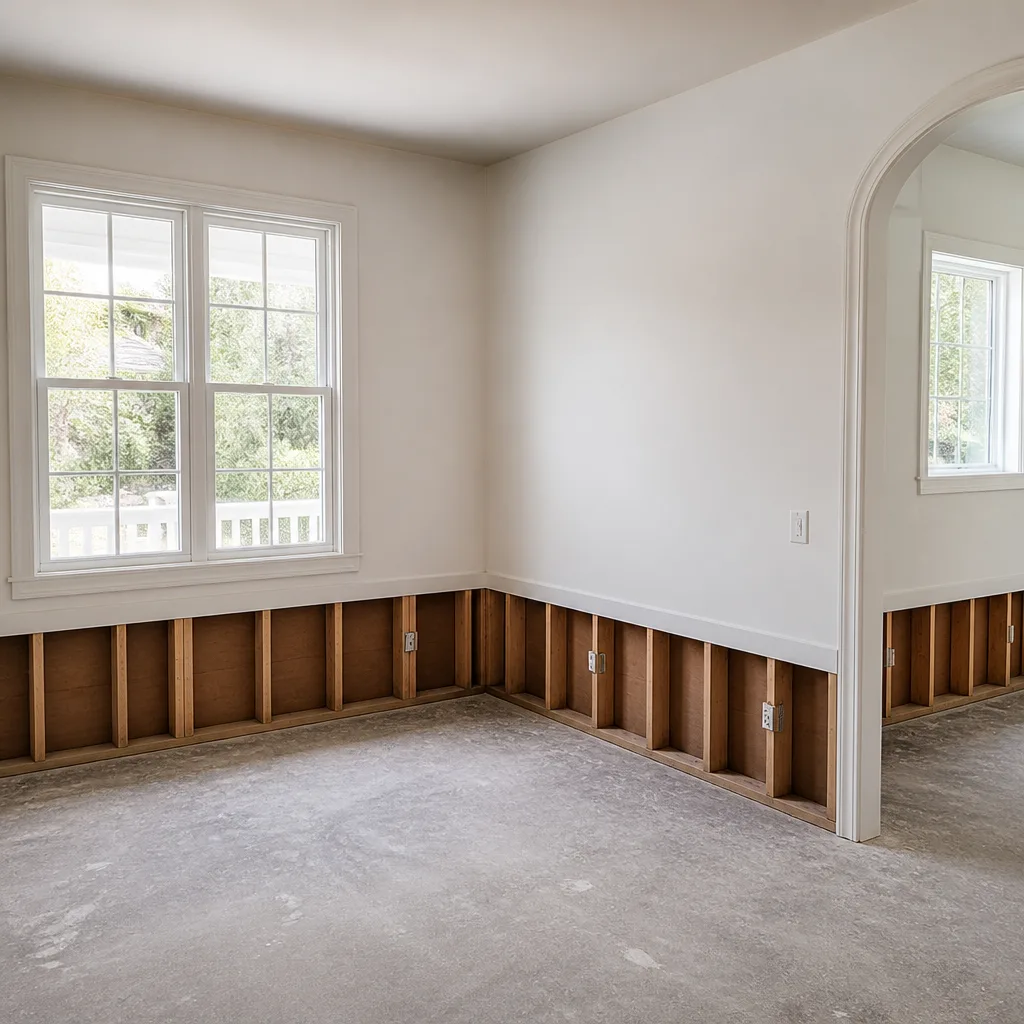
But Category 2 and Category 3 losses have no legitimate DIY window, regardless of visible extent. The contamination requires antimicrobial treatment, affected porous materials must be removed under containment protocols, and the drying process must be verified with moisture meters, not touch. The same applies to any Category 1 loss where water has wicked into wall cavities, under baseboards, or beneath vinyl or laminate flooring. The visible water is only a fraction of what is trapped in the structure. Water Damage Restoration in Lakeview follows the same category logic, because the standard does not change by ZIP code.
The Equipment Gap: Why Box Fans and Dehumidifiers Fail
The most persistent myth in restoration is that more airflow plus a store-bought dehumidifier equals professional drying. It does not. Professional restoration firms dry structures using psychrometrics: the science of moisture movement through materials and air. The goal is not to dry the surface. The goal is to bring every affected material back to its dry standard, including what is inside wall cavities, beneath flooring, and behind baseboards.
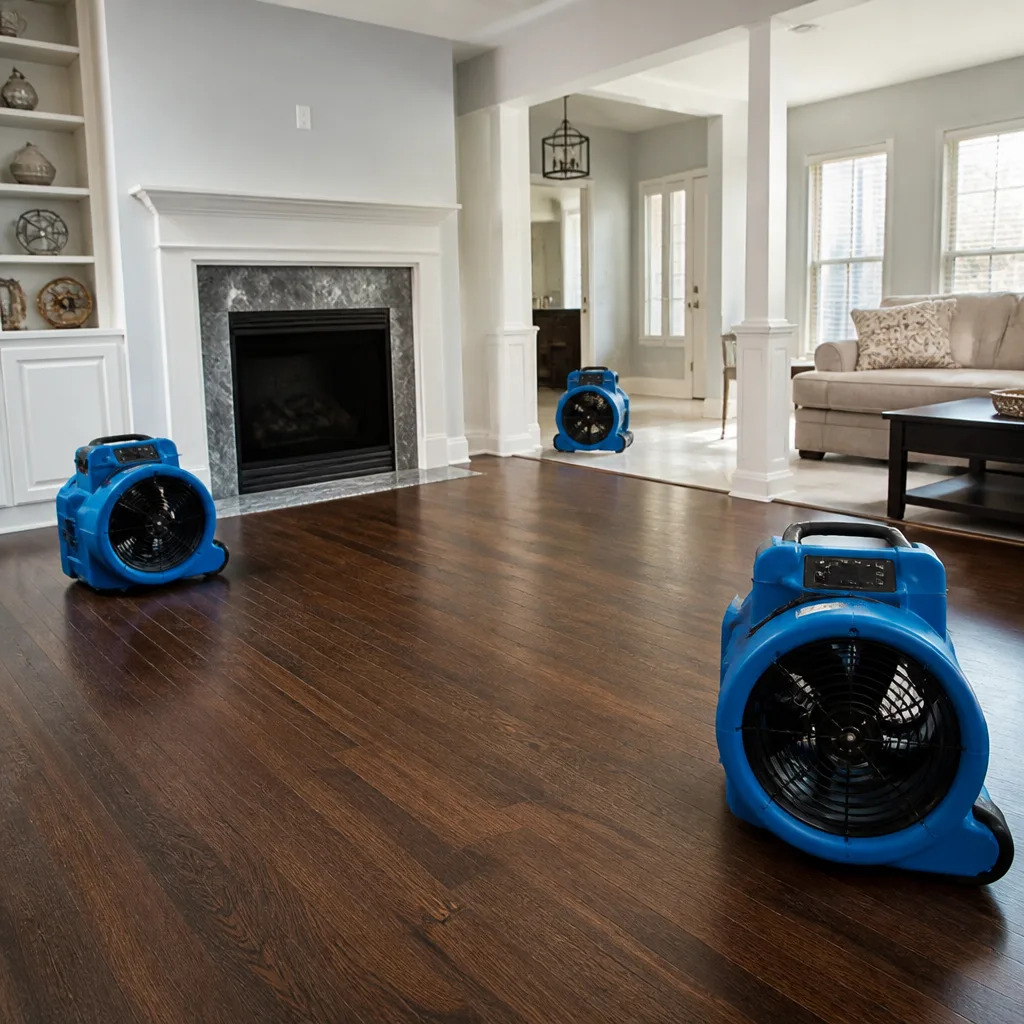
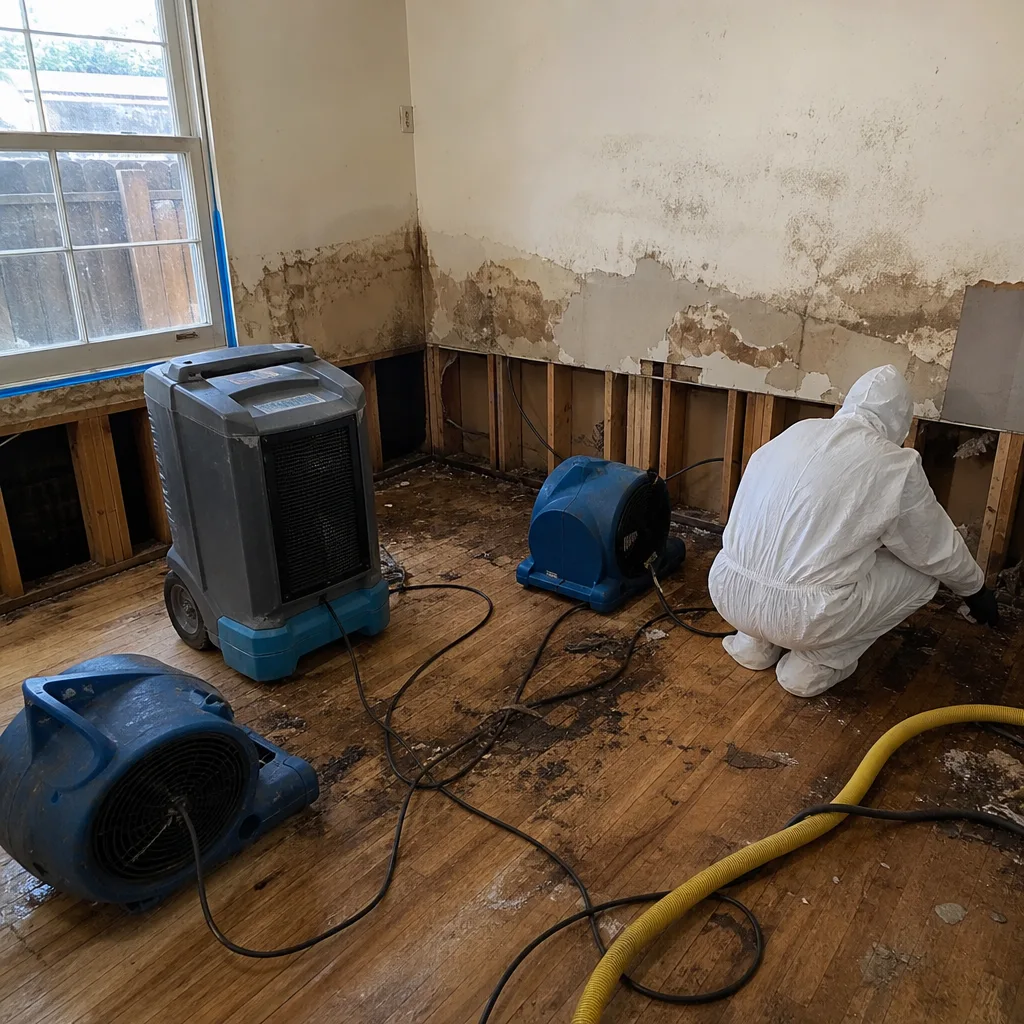
Consumer-grade dehumidifiers remove moisture from room air, and they do that slowly. A typical hardware store dehumidifier removes 20 to 30 pints per day under ideal conditions. A professional low-grain refrigerant dehumidifier from Dri-Eaz or Phoenix removes 70 to 140 pints per day while operating efficiently in the high-humidity conditions of a water-damaged room. Box fans push air across surfaces, which does help evaporate surface moisture, but they do not create the air pressure differentials required to pull moisture from wall cavities or dense materials like hardwood subflooring. That requires professional air movers positioned for directed airflow and, in many cases, injection drying systems.
The equipment gap is also a time gap. Professional drying typically achieves a dry standard in three to five days. DIY drying often runs a week or more, and every additional day of elevated moisture is a day of microbial growth. Secondary damage, meaning mold growth and material deterioration, begins at 48 to 72 hours. This is not a matter of effort. Costa Mesa’s coastal humidity levels work against slow drying, particularly in older homes near the Newport Beach border where air exchange rates are limited by construction methods.
This is why Oxford Restoration Co uses industrial-grade equipment from Dri-Eaz, Phoenix, and Injectidry. The Injectidry system is particularly relevant for homeowners weighing DIY against professional outcomes, because it dries wall and floor cavities from the inside, forcing air through the hidden spaces where mold establishes itself first. That is the difference between drying what you can see and drying what you cannot. It is also the difference between a complete restoration and a future mold discovery.
Insurance and DIY: Actions That Void or Weaken Your Claim
Insurance policies require the policyholder to mitigate further damage. That is a legal obligation, not a suggestion. But “mitigate” has a narrow meaning, and crossing it creates problems. The three most common ways DIY response damages an insurance position are documentation failure, delayed notification, and improper material removal.
Documentation failure is the most common. The insurer needs a record of the loss condition before any cleanup begins. Photos, videos, and a written timeline. Homeowners who move furniture, extract water, cut drywall, and throw away damaged materials before taking adequate photos have removed the primary evidence the insurer uses to evaluate scope. You cannot prove what you threw away. The result is often a reduced settlement based on what the insurer can confirm, not what actually happened.
Delayed notification creates its own issues. Most policies require prompt reporting, and a delay that allowed secondary damage to develop can be grounds for partial denial. A homeowner who spent two weeks running fans on a water loss before calling the insurer has given the carrier a defensible reason to pay less. The argument is straightforward: the additional damage was preventable, and the policyholder’s delay caused it.
Improper material removal is the third failure. Cutting out drywall or pulling carpet during an active Category 2 or 3 loss spreads contaminants through the home. If the insurer’s adjuster can demonstrate that the homeowner’s actions increased the scope of the loss, the increased portion can be excluded. Worse, some homeowners perform partial mitigation, stop, and then file a claim. The insurer sees a loss that was partially addressed without professional documentation, and the claim process becomes adversarial from the first call.
Professional restoration changes this dynamic. The restoration firm documents the loss condition, logs moisture readings and drying progress, and produces the scope documentation insurers expect. The IICRC-certified process used by Oxford Restoration Co home is built around this documentation discipline, because the standard exists partly to give the insurance industry a consistent, defensible restoration reference.
Mold Liability in California: What DIY Response Creates
California has specific mold disclosure requirements that directly affect DIY decisions. Under California Civil Code 1102, sellers of residential property must disclose known mold issues. Under the state’s Toxic Mold Protection Act, landlords have disclosure obligations for tenants. In Costa Mesa, where many homes are rental properties or second homes, this legal context matters more than most homeowners realize.
The practical implication is that a homeowner who discovers mold and does a DIY cleanup has not removed the disclosure obligation. They have created one with incomplete elimination. If you clean visible mold with bleach and repaint, and the mold returns or remains hidden in a wall cavity, and you sell the home without disclosing it, you have created a material omission in the sale. California courts do not look kindly on this. The buyer who discovers mold behind a freshly painted wall has a legal claim, and the fact that you attempted remediation is not a defense if the remediation failed.
The same applies to rental property. A Costa Mesa landlord who does DIY mold cleanup and then rents the unit has assumed liability if a tenant later develops respiratory symptoms and testing reveals mold. The landlord’s defense is usually “I cleaned it,” which fails when inspection shows the mold remains. The legal standard in mold exposure claims often depends on whether a recognized professional standard was followed. IICRC S520 is that standard for mold remediation. A DIY effort, by definition, cannot meet it.
For landlords, this is a structural argument for professional handoff. Mold Remediation in Lakeview addresses the same liability framework for adjacent communities, but the legal exposure is identical in Costa Mesa. The cost of professional remediation is almost always less than the cost of a failed DIY remediation that becomes a disclosure lawsuit.
The First 60 Minutes: Legitimate Protective Actions vs. Professional Handoff
Here is a clear framework for the opening hour of a water loss, drawn from the IICRC S500 standard. Every Costa Mesa homeowner can do these four steps safely, and they meaningfully reduce the eventual restoration scope.
- Stop the source. Shut off the supply valve, turn off the appliance, close the main if necessary. Duration of water exposure is the single largest driver of damage severity and category degradation.
- Remove standing water. Use a wet vacuum or mop and bucket to extract visible water from hard surfaces. Extraction removes the largest portion of moisture and shortens the drying phase regardless of who handles it.
- Remove water from flooring. Pull back wet carpet and remove the pad beneath it. Carpet pad acts as a reservoir; removing it is low-risk and prevents the water from spreading. Place aluminum foil under furniture legs to prevent staining.
- Document everything before you finish. Photograph the source, the visible water lines on walls and floors, the affected area, and any materials you move or remove. Write down when you noticed the loss and what you did. This documentation protects you whether you hand off or continue.
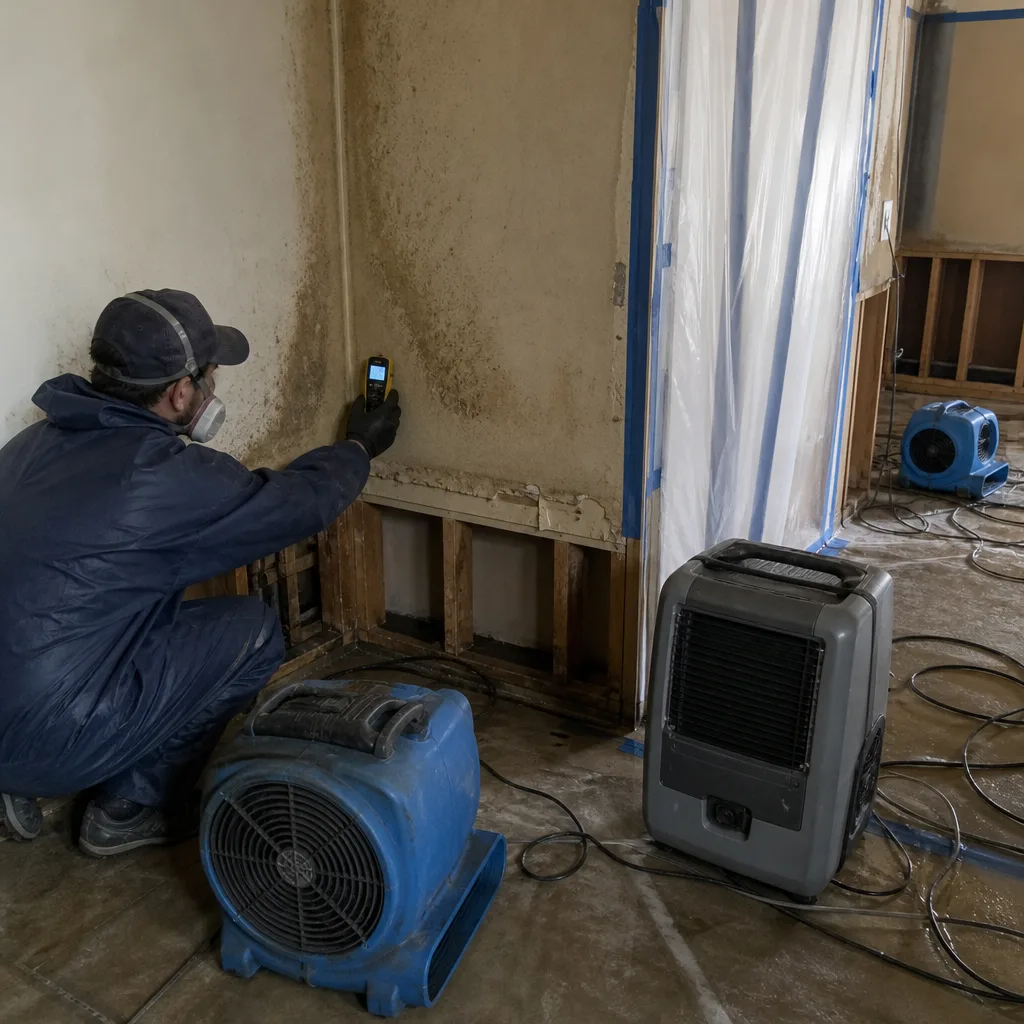
Where professional handoff is technically required: if the water is Category 2 or 3, if the affected area exceeds roughly 10 square feet of porous materials, if water reached wall cavities or subfloor, if the loss occurred more than 24 hours ago, or if you cannot verify dryness by moisture meter at the end of your effort. None of these thresholds are conservative. They are the minimum conditions under which a complete outcome is achievable without professional equipment and a IICRC-certified process. Continuing past these points is not DIY. It is gambling.
Fire Damage: Why DIY Soot Removal Is a Category Error
Fire damage looks simple at first glance. Wipe the soot, wash the walls, repaint. But soot is not dirt. It is a complex mixture of burned materials that includes acidic residue from plastics and synthetics. In a typical Costa Mesa home fire, the smoke deposits include the combustion byproducts of carpet, upholstery, electronics, and building materials. That residue etches surfaces over time and off-gasses for weeks.
DIY soot removal commonly fails in three ways. First, homeowners use water-based cleaners on protein soot from kitchen fires, which smears the residue into paint rather than removing it. Second, they wipe without HEPA filtration, which redistributes the finest particles into ductwork and other surfaces. Third, they do not address the residual odor, which lives in porous materials and cavities, not on painted surfaces.
Professional fire restoration addresses the residue, the odor, and the embedded contamination as one system. Surfaces are cleaned with appropriate chemistries for the specific soot type. The air is scrubbed with HEPA filtration. Porous materials are sealed or removed based on contamination level. Ozone treatment or hydroxyl generation addresses the odor that persists after cleaning. Fire Damage Restoration in Lakeview follows this same protocol, and it is the protocol that determines whether the home smells like fire a year later.
The threshold for professional handoff on fire damage is lower than for water. If the fire reached the point of smoke damage to multiple rooms, if there was water from firefighting, or if odor persists after surface cleaning, the loss requires professional treatment. There is no legitimate DIY window for structural fire damage. The restoration standard is not “looks clean.” It is “pre-loss condition,” and that standard includes what you cannot see.
Cost Comparison: DIY Spending vs. Professional Restoration
The cost anxiety around professional restoration is real, and it deserves an honest answer. Here is what a Costa Mesa homeowner should expect, presented as the actual decision on the table.
DIY Restoration Costs (Typical Small Category 1 Loss)
- Wet/dry vacuum rental: $35 to $70 per day
- Box fans: $30 to $80 (purchased, two units)
- Consumer dehumidifier rental: $40 to $80 per day, or $200 to $300 purchased
- Moisture meter (pinless): $40 to $120 for a basic consumer model
- Cleaning supplies and disinfectant: $30 to $60
- Total DIY outlay: $175 to $410 for a small loss, assuming everything works
Professional Restoration Costs (Insurance Scope, Moderate Category 1 to 2 Loss)
- Emergency extraction: typically included in the overall scope
- Drying equipment deployment: $75 to $150 per day per room, usually 3 to 5 days
- Moisture monitoring and documentation: included in the professional service
- Antimicrobial application where required: included in the scope where indicated
- Typical professional scope: $1,200 to $4,500 for a contained multi-room loss, with the homeowner’s out-of-pocket usually limited to the deductible
The honest framing is not “DIY is cheaper.” DIY is cheaper in the moment if nothing goes wrong. The question is what the failure state costs. In our experience serving Costa Mesa homes, we regularly see DIY attempts that end one of three ways. First, the drying is incomplete and mold appears weeks later, at which point the restoration scope includes mold remediation that is larger than the original water mitigation would have been. Second, the homeowner does not document the loss properly, and the insurance settlement is reduced below what it would have been with professional documentation. Third, the homeowner spends money on rentals and equipment, does the work, and then calls us anyway because the moisture meter shows readings they cannot bring down.
The calculation is not $300 versus $2,000. It is $300 plus the cost of the failure state versus $2,000 minus what insurance covers. Many homeowners do not realize that professional restoration is covered under their homeowners policy, subject to the deductible. The out-of-pocket for a professionally handled covered loss is often comparable to a serious DIY attempt that fails.
Common Mistakes to Avoid
- Using bleach on mold. Chlorine bleach does not kill mold on porous surfaces. It bleaches the color while leaving the organism alive beneath the surface, and the water in bleach feeds remaining spores. This is the most common DIY error we see in Costa Mesa homes.
- Relying on touch to judge dryness. Materials can feel dry to the hand while retaining 15 to 20 percent moisture content inside, which is enough for mold. Without a quality moisture meter, you are guessing, and the guess is usually optimistic.
- Running a household HVAC system during a water loss. The system distributes moisture and spores throughout the home and can contaminate ductwork. Shut the HVAC down for the affected zone until professional assessment.
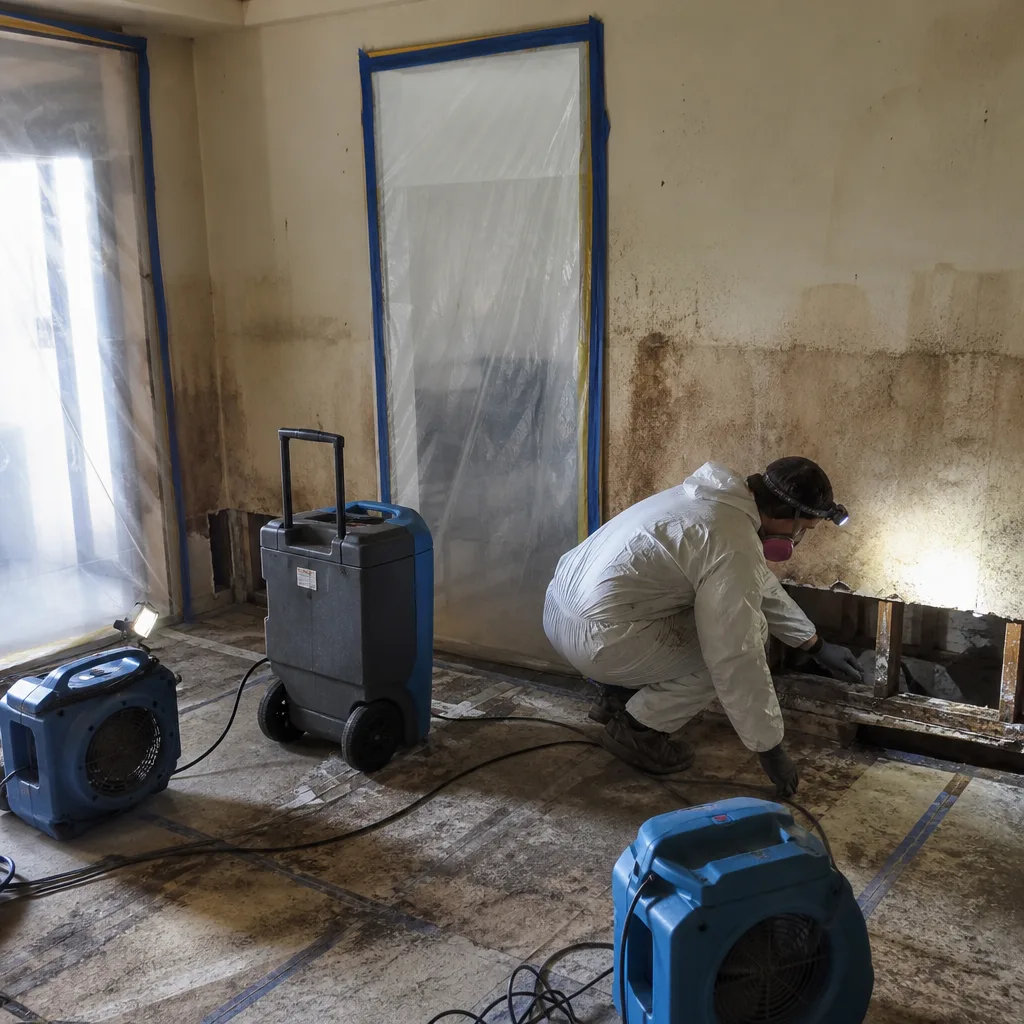
- Removing drywall or flooring during a Category 2 or 3 loss. Without containment, the demolition itself spreads the contaminants. Containment and negative air pressure are prerequisites for safe material removal in these categories.
- Treating visible mold as the whole problem. Visible mold in a bathroom or behind a baseboard is usually the expression of a moisture source you have not found. Removing the visible growth without addressing the source guarantees recurrence, often larger than the original appearance.
- Not notifying insurance because the deductible seems high. A $2,000 deductible is a known cost. Undiscovered mold growth, structural rot, and a future undisclosed-property claim are unquantifiable. The deductible math is rarely the deciding factor when the full failure cost is considered.
- Assuming a water loss is dry because the visible water is gone. Water that has wicked into wall cavities and subfloor can remain for weeks. The visible surface is the least of the problem in a typical small Costa Mesa home flood.
When to Call a Professional
Call a professional when the water is Category 2 or 3, when the loss has affected wall cavities or flooring underlayment, when visible mold exceeds 10 square feet, when a fire has caused smoke damage to multiple rooms, or when you have already attempted drying and cannot verify a dry standard by meter. Also call if the loss is insurance-covered: the documentation a professional provides is worth the deductible many times over in claim outcomes. Oxford Restoration Co offers free estimates in Costa Mesa, call (877) 265-8058.
Frequently Asked Questions
A Category 1 loss comes from a sanitary source, such as a supply line, faucet, or shower, and you caught it within minutes, extracted the water fully, and the affected area is small with no wall cavity or subfloor penetration. If you can answer yes to all of those conditions, dry it thoroughly, verify with a moisture meter if available, and document everything. If any condition fails, the loss requires professional attention.
Most homeowners policies in California cover sudden and accidental water damage restoration, mold remediation when the mold results from a covered water event, and fire damage restoration, subject to your deductible and policy limits. The professional restoration firm documents the loss and scope in the format insurers expect, which supports the claim. Coverage questions should go to your adjuster, but the documentation a IICRC-certified firm provides is a significant advantage in settlement.
Professional restoration firms serving Costa Mesa typically respond within one to two hours for active water losses because the response time directly affects the total restoration scope. The first 24 hours determine whether the loss stays Category 1 or degrades. Call (877) 265-8058 for an exact response window, estimates are free.
This approach usually costs more than professional handoff from the start. Mold that appears weeks after a DIY drying attempt means the moisture was never fully removed, and the restoration scope now includes mold remediation on top of the original water loss. The professional response is cheaper on average when invoked before the secondary damage develops.
No, and this is a common misunderstanding. California law requires disclosure of known mold issues regardless of whether you attempted remediation. If your DIY cleanup fails and mold remains, you have not removed the disclosure obligation. You have created a material omission with legal exposure. Professional mold remediation following the IICRC S520 standard is the only approach that provides a defensible remediation position.
The most common error is underestimating where the water actually went. Costa Mesa homes, particularly older ones in central Costa Mesa and the Eastside, have wall construction and flooring assemblies that wick water quickly. The water you cannot see is the water that causes mold and rot. The second most common error is not documenting the loss before cleanup, which weakens the insurance position irreparably.
The Bottom Line
The DIY versus professional decision in damage restoration is not primarily about skill or cost. It is about the technical thresholds that determine whether your response creates a complete outcome or a hidden failure. A small Category 1 loss with immediate response and thorough drying has a legitimate DIY window. Everything beyond that requires the equipment, the documentation, and the protocol discipline that only professional restoration provides. We have seen the failure states in Costa Mesa homes: mold discovered behind a DIY-dried wall, a claim reduced because the evidence was thrown away, a landlord facing liability over a bleach-cleaned bathroom. The IICRC standard exists because water, smoke, and mold behave according to physics and microbiology, not good intentions. The decision is whether you want to be the one who handles it correctly the first time, or the one who pays to fix it later. For more guides & resources, visit our blog.x a response that made it worse.
Written by the team at Oxford Restoration Co, serving Costa Mesa since 2011.
See the difference
 Before
 After
 Before
 After
 Before
 After