
Water Damage Restoration What It Really Costs: What Costa Mesa Homeowners Pay in 2026
Water damage restoration in Costa Mesa typically costs between $3,800 and $18,500 in 2026, with most homeowners landing between $5,500 and $11,000. The range is wide because restoration costs track water category, the materials affected, and response time more than square footage. If you’re staring at a soaked wall right now and want a straight answer rather than an insurance adjuster’s shrug, call (877) 265-8058 and we’ll walk you through what you’re actually looking at.
Why Two Identical Costa Mesa Homes Can Get Quotes $8,000 Apart
We’ve walked into two homes on the same street in Mesa Verde, both with water heaters that failed on the same night, and written estimates that differed by more than $8,000. Same square footage, same flooring, same year built. The difference came down to three factors most homeowners never hear about until the bill arrives: water category, material porosity, and elapsed time before mitigation started.
California’s average water damage insurance claim runs around $11,000, but that number hides more than it reveals. A Category 1 line break that gets extracted within four hours might run $4,500. The same leak left sitting over a weekend, seeping into baseboards, wicking up drywall, and feeding microbial growth in the wall cavity, can push past $22,000 before reconstruction even starts.
The first six hours decide almost everything. That’s not a sales line. That’s how moisture migration works in coastal Orange County’s climate, where our mild temperatures and ambient humidity keep materials damp longer than they would in a dry inland market. Water keeps moving through porous materials until someone actively removes it. Drywall wicks upward. Wood framing absorbs laterally. Tile underlayment traps moisture against the slab. Each passing hour expands the affected zone.
What Actually Drives Your Number
- Water category (IICRC standard S500 classification) – contaminated water requires containment, antimicrobial treatment, and more demolition
- Material porosity – carpet pad and drywall absorb fast; vinyl plank and concrete absorb slowly but trap moisture underneath
- Time to mitigation – every 24 hours of saturation expands the affected perimeter and can bump classification
- Drying complexity – wall cavities, under cabinets, and between floors require specialty systems like Injectidry that plain fans cannot reach
- Reconstruction scope – what has to be rebuilt after drying, not just dried
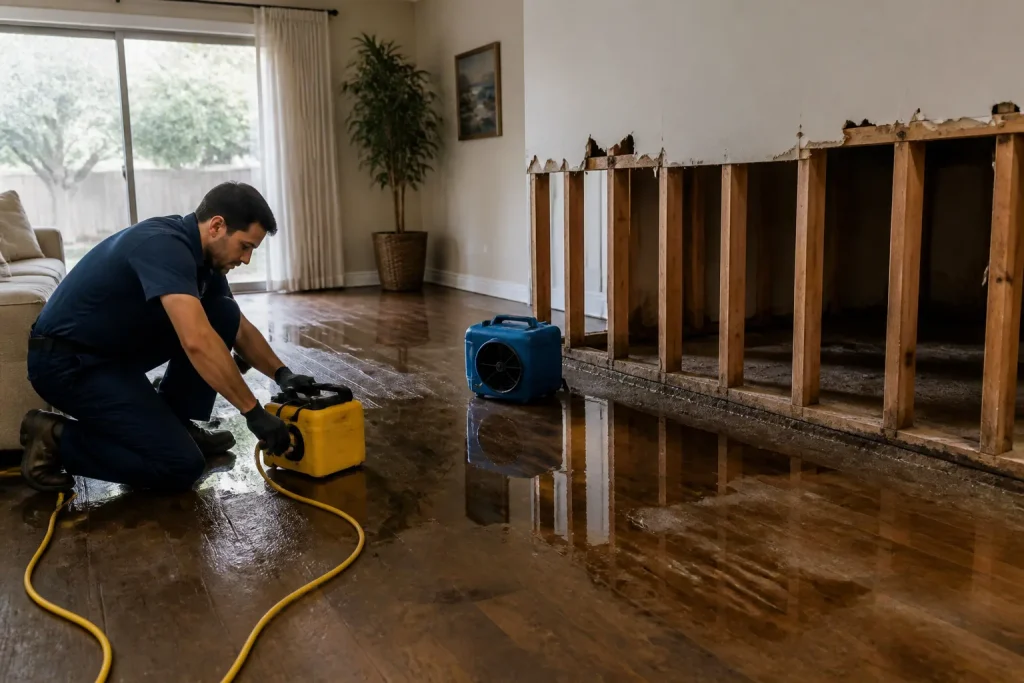
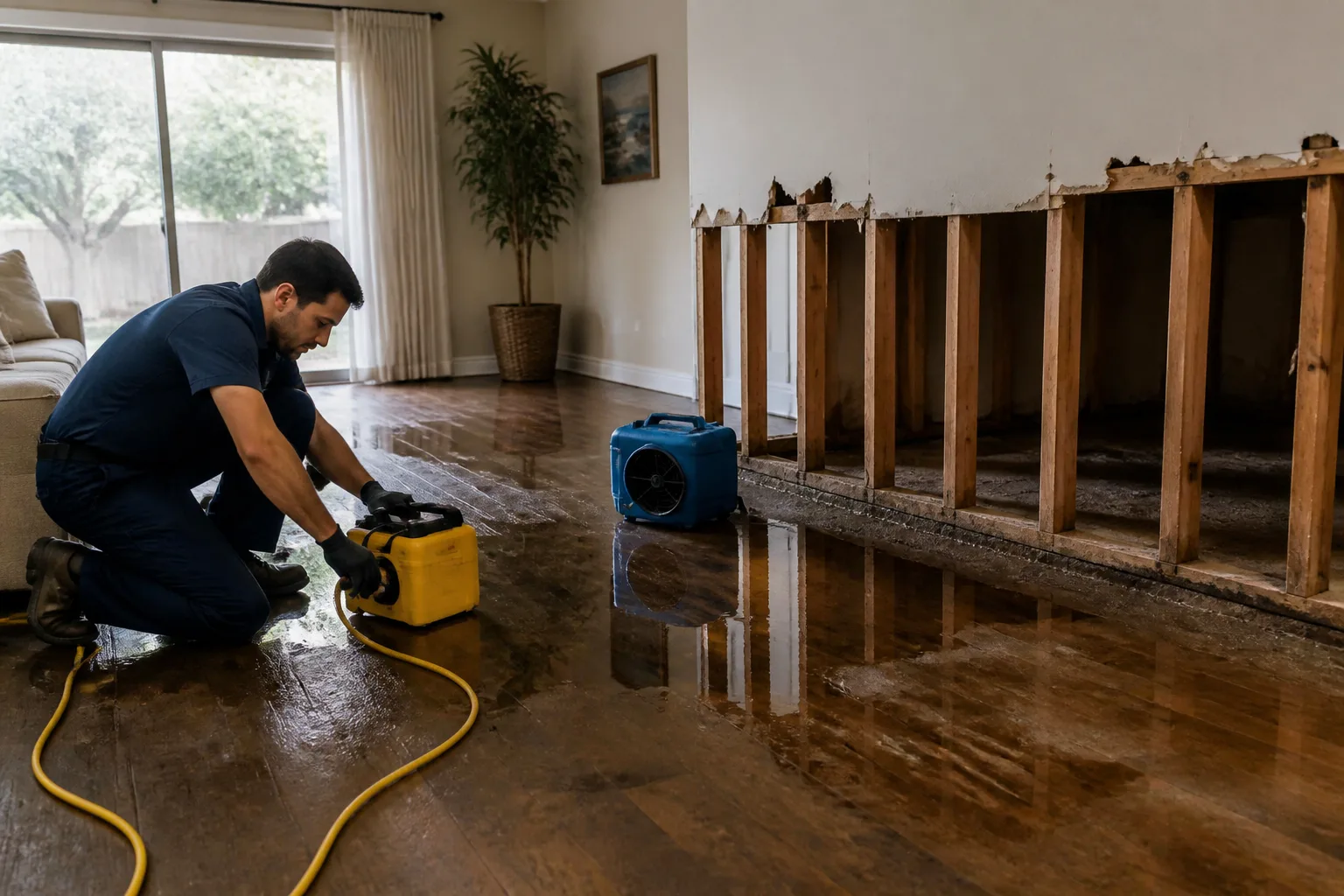
We’ve pulled wet drywall out of a garage over in College Park where the homeowner assumed a fan and open windows would handle it. Four days later, the moisture meter read 100% saturation at 18 inches up the wall. The fan moved surface air. The water was inside the wall cavity, exactly where our Dri-Eaz extraction and Phoenix dehumidification systems are designed to reach. By the time we got there, the affected area had tripled. The mitigation cost tripled with it. That’s not the homeowner’s fault. Nobody explains this until it’s too late.
This is also where the difference between a restoration specialist and a general contractor shows up fast. A contractor sees wet drywall and the plan is tear out, then rebuild. A restoration specialist runs moisture mapping first, and if the framing is sound, an Injectidry cavity drying setup can save the wall entirely. Demolition is a cost. Avoiding demolition is a savings. Our Oxford Restoration Co home team approaches every job with that math in mind.
Cost Breakdown by Water Category: Clean, Gray, and Black Water
Restoration estimators use the IICRC S500 standard to categorize water based on its source and contamination level. The category changes everything about process, equipment, safety protocols, and final price. Here’s what Costa Mesa homeowners actually pay in each bracket, based on typical single-room incidents with professional mitigation:
| Water Category | Source Examples | Typical Mitigation Range (Single Room) |
|---|---|---|
| Category 1 – Clean Water | Supply line break, faucet failure, appliance water line | $1,800 – $4,200 |
| Category 2 – Gray Water | Washing machine discharge, dishwasher overflow, sump pump failure | $3,500 – $8,500 |
| Category 3 – Black Water | Sewage backup, floodwater, storm surge intrusion | $7,000 – $18,000+ |
Category 3 contamination is where estimates jump sharply, and the jump has nothing to do with greed. Black water carries pathogenic bacteria and requires full containment barriers, negative air pressure, antimicrobial application, and in many cases, removal of porous materials that would have been salvageable with clean water. A carpet that could be extracted and dried after a supply line break must be cut, bagged, and disposed of after a sewage backup. That disposal isn’t free. Orange County’s transfer station fees for contaminated construction debris run higher than standard waste streams, and the transportation has to be handled under containment protocols.
The classification can also change over time. Clean water left standing for 48 to 72 hours in a warm Costa Mesa garage can degrade to Category 2 as bacterial growth begins. That’s a cost-creep factor your insurance adjuster will absolutely apply if the timeline supports it. It’s also why the first six hours matter so much. The water category you have at hour one may not be the category you have at hour forty-eight.
How Delay Changes Your Costs: The 24-Hour Multiplier Effect
Moisture doesn’t stay where it started. That’s the single most expensive fact in the restoration business.
Here’s what happens when water sits unaddressed in a Costa Mesa home, hour by hour:
- Hours 0-6: Water remains mostly contained to the point of release. Extraction and targeted drying can often save flooring, baseboards, and drywall. Typical mitigation: $1,800-$4,000.
- Hours 24-48: Water has wicked into drywall, under baseboards, and into subfloor. Affected area expands by 30-60%. Material removal begins. Typical mitigation: $4,000-$8,000.
- Hours 48-72: Standing water has saturated framing, created mold-favorable conditions, and likely elevated the water category. Containment and antimicrobial work are now required. Typical mitigation: $6,000-$12,000.
- Hours 72+: Structural drying may still be possible, but secondary damage (mold, warping, delamination) means reconstruction scope grows significantly. The job is now a restoration-and-rebuild, not just mitigation. Typical combined cost: $12,000-$25,000+.
Costa Mesa’s climate makes the 48-72 hour window more dangerous than many homeowners realize. Our average relative humidity hovers between 65% and 75% for much of the year. That’s well above the threshold where mold growth accelerates. The EPA’s guidance on mold remediation timelines assumes 24-48 hours of wet conditions before growth starts. In our coastal air, plan on the shorter end of that range.
The lesson isn’t that everyone should panic at the first drip. It’s that selective inaction is expensive. A fan in a window is not mitigation. A wet-dry vac is not extraction. Professional-grade Phoenix dehumidifiers and Dri-Eaz air movers move volumes of air that consumer equipment simply can’t match, and the moisture mapping technology tells us where the water actually went, not where you think it went.
What Xactimate Is and Why It Controls Your Insurance Payout
If you’ve never filed a water damage claim, you’ve probably never heard of Xactimate. That’s about to change the moment your adjuster sends an estimate.
Xactimate is the pricing software used by nearly every major insurance carrier to calculate restoration costs. It uses localized pricing databases to establish line-item costs for every task: extraction per square foot, dehumidifier rental per day, drywall removal per linear foot, antimicrobial application per square foot. Insurance companies use it. Restoration companies use it. The difference is in how the line items get built.
A legitimate IICRC-certified restoration firm builds the Xactimate estimate based on what the job actually requires: the number of air movers needed for the affected square footage, the days of dehumidification, the containment setup, the monitoring visits. A low-ball operator builds the estimate to fit a target number, then quietly omits line items and hopes the homeowner doesn’t notice when the final invoice arrives or the work doesn’t match the original scope.
Where the divergence shows up most in Costa Mesa:
- Drying equipment days: A proper dry-out takes 3-5 days on average. A cut-rate estimate might price one day of equipment and claim the rest is “unnecessary.”
- Containment: Category 2 and 3 jobs require plastic containment barriers and negative air pressure. This line item can run $500-$1,500. Omission is common in low estimates.
- Monitoring visits: Proper restoration includes moisture meter readings throughout the drying process. Some operators skip this entirely and bill for it anyway, or skip it and don’t bill, leaving you with an unverified dry-out.
- Demolition disposal: In Orange County, contaminated material disposal requires specific handling. The disposal line should reflect actual weight and transfer fees.
Our advice: if you receive two estimates and one is 40% lower, ask to see the line items. Not the summary page. The actual line items. The missing numbers will tell you exactly what the lower bidder is planning to skip. In restoration, that’s almost always equipment days, containment, or monitoring. None of which you want skipped. For more on how we handle water damage as a process rather than a single visit, see our Water Damage Restoration in Lakeview page.
What “Depreciation” Means on Your Insurance Estimate
Depreciation is the insurance industry’s way of saying your damaged materials had age and use before the loss, so they pay replacement cost minus depreciation, then release the depreciated amount only after the work is actually completed.
Here’s the practical version. Your five-year-old laminate flooring gets destroyed by a toilet overflow. The adjuster’s estimate prices new flooring at $4.50 per square foot. Insurers may say that flooring had an expected life of 15 years, so after five years of use, it had lost a third of its value. The estimate shows $4.50 per square foot minus 33% depreciation, or about $3.00 per square foot. You’ll get the $3.00 per square foot now, and the remaining $1.50 per square foot once you submit proof that the replacement was actually purchased and installed.
The problem in Costa Mesa isn’t the depreciation formula. It’s scope completeness. If the adjuster’s estimate only covers 200 square feet of flooring but the actual affected area is 340 square feet, the depreciated amount is small compared to the missing 140 square feet that was never included in the first place. That’s where a credentialed restoration team with Xactimate experience becomes essential. We can identify scope gaps before you sign anything, and we can document the actual affected area with moisture mapping data that supports the claim.
Materially incomplete scopes are the most common dispute we see. Missing line items, undercounted square footage, no containment for a Category 2 loss, no antimicrobial application after sewage contact. These omissions aren’t always bad faith. Adjusters are busy, and some are working from photos rather than physical inspection. But the gap between what the estimate covers and what the job actually requires comes out of your pocket unless someone catches it early.
This is where being a specialist matters. We do restoration work every day in Costa Mesa and the surrounding Orange County market. We know what a dry-out actually costs here because we run the equipment, pay the labor, and haul the debris. Our estimate is built on measurable conditions and IICRC standards, not on what a pricing database thinks might be reasonable from three states away.
Costa Mesa-Specific Cost Factors Most National Articles Miss
National articles about water damage costs quote ranges that don’t reflect what you’ll actually pay in Costa Mesa. Here’s what changes locally:
Labor rates. Orange County restoration labor runs materially higher than the national average used by generic pricing guides. Certified water damage technicians in our market earn more than their counterparts in the Central Valley or the Inland Empire, and that cost shows up in every line item.
Disposal fees. Orange County’s construction and demolition debris processing is handled through facilities with specific acceptance requirements for contaminated materials. Category 3 debris cannot go through standard transfer stations the way it might in other regions. The labor and fees associated with compliant disposal are real numbers on your estimate.
Permit requirements. If water damage requires structural repair in Costa Mesa, you’re under California building codes and Orange County permit requirements. A mitigation-only job typically needs no permit. Once you’re into reconstruction: removing and replacing drywall, flooring, or any structural element: the permit conversation starts, and it adds cost and time. The difference between mitigation-only and mitigation-plus-reconstruction is often the difference between a $6,000 job and a $16,000 job, and that line sits exactly where you’d guess it does.
Coastal humidity. Drying times in Costa Mesa run a day or two longer than inland restoration jobs with identical damage profiles. That means more equipment days on your estimate. The IICRC standard drying goal is based on returning materials to their pre-loss moisture content, and in our climate, reaching that target simply takes longer and requires more dehumidification capacity.
Slab-on-grade construction. Most Costa Mesa homes built after 1960 sit on concrete slabs. Water that reaches the slab doesn’t drain into a crawlspace; it sits and spreads horizontally, traveling under flooring and into wall sill plates. This damage pattern requires different drying strategies, often involving specialty systems to dry the area under vinyl plank or tile without pulling the entire floor. The cost to dry a slab-wet floor properly is usually higher than the cost to dry a raised-floor home with a crawlspace and natural ventilation, but it’s still far cheaper than replacing the entire floor because the moisture wasn’t addressed.
Most of these are invisible to a national cost calculator. They show up as small line-item differences that add up to thousands of dollars. If you’re comparing a Costa Mesa estimate against a “national average” from a website, remember that the national average includes markets where restoration labor costs half what it does here and where contaminated debris can be dumped for a fraction of our transfer fees.
When to Call a Pro (and When You Can Handle It Yourself)
We’re not going to tell you every water problem needs a restoration team. That’s not true, and saying it would make us the kind of operator we’re competing against. Here’s the honest breakdown.
You can probably handle it yourself if: the water is clean (a supply line that you caught immediately), the affected area is small (under 10 square feet of flooring or drywall), you have the water stopped, and you can get the area fully dry within 24 hours using fans and a dehumidifier. We’ve seen homeowners in Eastside Costa Mesa handle exactly this kind of minor spill with a shop vac and three days of dry California air.
Call a professional if: any of the following is true – the water came from a sewage line, a washing machine that handles diapers or heavily soiled loads, or stormwater intrusion; the affected area is larger than a small bathroom; water reached baseboards, wall cavities, or the floor under vinyl plank or tile; the water sat for more than 24 hours; or you can hear water but can’t see where it’s going. These are the jobs where the cost curve bends sharply upward if you wait, and where the difference between a professional dry-out and a DIY attempt is measurable in thousands of dollars and potential health issues.
If mold is already visible, don’t attempt DIY removal. Disturbing mold without containment sends spores into your HVAC system and throughout the house. For that situation, see our Mold Remediation in Lakeview page. If the damage came from a fire suppression system or a fire-related water event, the water damage is often accompanied by smoke and soot damage, which changes the restoration approach entirely. Our Fire Damage Restoration in Lakeview page covers that combination.
The Bottom Line
Water damage restoration in Costa Mesa in 2026 costs between $3,800 and $18,500 for most single-room incidents. The final number depends on water category, elapsed time before mitigation, material porosity, and whether the job stays in mitigation or expands into reconstruction. Every 24 hours of delay adds cost, not linearly but in step functions as the affected area grows and the classification degrades. The single most effective cost-control move available to any Costa Mesa homeowner is calling a qualified mitigation team the moment water is discovered, not after the weekend, not after the adjuster gets back to you, but when the puddle is still warm.
If you’re in Costa Mesa and need help sorting out what you’re actually dealing with, Oxford Restoration Co offers free estimates and straight answers. Call (877) 265-8058 and we’ll tell you what you need to do, even if the answer is “get a fan and keep an eye on it.” We’d rather give you honest guidance and earn your call next time than oversell you on a small problem today.
Frequently Asked Questions
Most Costa Mesa homeowners pay between $5,500 and $11,000 for professional water damage restoration in 2026, with the full range spanning roughly $3,800 to $18,500 depending on water category, affected area, and how quickly mitigation started. Category 3 (sewage) jobs run at the top of that range. Call (877) 265-8058 for an exact quote based on your specific situation – estimates are free.
Homeowners insurance typically covers sudden and accidental water damage, such as a burst pipe or appliance failure, but not gradual damage like a slow leak that has been going on for months. Sewage backup coverage often requires a specific endorsement. The key to maximizing your claim is having a restoration team that can document the full affected scope before you accept the adjuster’s estimate. We work directly with adjusters and provide photo documentation and moisture mapping data throughout the process.
In a water emergency, response time determines the final cost, and we dispatch to Costa Mesa water damage calls the same day you call. The goal is on-site within hours, not days, so extraction and drying can begin before the damage expands. Call (877) 265-8058 and tell us what happened – we’ll give you an honest timeline and the steps you should take right now while you wait.
It depends entirely on where the water went. If moisture is confined to a non-porous surface, extraction and drying may be sufficient. But once water reaches drywall, baseboards, subfloor, or wall cavities, a cleaning-only approach leaves moisture trapped inside the building envelope. We use moisture meters to map the actual affected area, and we’ll show you the readings. If drying is sufficient, we’ll tell you that. If demolition is needed, we’ll show you exactly which materials and why. No one should tear out your drywall without showing you the data.
Written by the team at Oxford Restoration Co, serving Costa Mesa since 2011.
Need Damage Restoration Help?
Call Oxford Restoration Co — licensed & insured, here with fast after-hours help in Costa Mesa.
(877) 265-8058