
How to Choose the Right Damage Restoration Company in Costa Mesa
The short version: choose a company with individually IICRC-certified technicians on staff, not just a firm-level certificate on the wall. Ask for their certification numbers and verify them in the IICRC database. If a company hesitates, that’s your answer. If you’d rather skip the research entirely and talk to a specialist now, call Oxford Restoration Co at (877) 265-8058.
Here’s the thing most people don’t realize until it’s too late: IICRC certification is not a single credential. It’s a tiered system. A company that holds only a Firm Certificate with no individually certified technicians on staff is the restoration equivalent of a hospital with no licensed physicians. The building has the right signage. That doesn’t mean the person holding the drill knows what they’re doing inside your wall cavity.
We’ve watched homeowners in Costa Mesa hire the wrong contractor because they moved fast under pressure. The result is usually the same: the water gets dried on the surface, the mold grows back in six weeks, and the insurance claim gets messy because the documentation doesn’t meet the adjuster’s standard. This guide exists so you can avoid that outcome.
The Credential Check: What “IICRC-Certified” Actually Means
The IICRC, or Institute of Inspection, Cleaning and Restoration Certification, is the recognized standard-setting body for the restoration industry. When a company says they’re “IICRC-certified,” that statement can mean one of two very different things.
A Firm Certificate means the company registered with the IICRC and agreed to follow its standards. It’s a business-level designation. It does not mean anyone on staff has passed a technical exam.
Individual certifications are what you’re looking for. The three you’ll see most often in water and mold work are:
- WRT (Water Restoration Technician): Covers the science of drying principles, extraction techniques, and moisture mapping.
- ASD (Applied Structural Drying): A more advanced credential focused on drying complex structures like wall cavities, crawlspaces, and multi-level buildings.
- AMRT (Applied Microbial Remediation Technician): Required for mold remediation work, covering containment protocols and safe removal practices.
Here’s the practical move: ask the company for the names and certification numbers of the technicians who will actually be on your job. Then go to the IICRC’s public database and verify those numbers yourself. A legitimate company will give you this information without hesitation. A company that gets defensive or vague is telling you something useful. We’re affiliated with the RIA and IFA as well, which means we’re held accountable to ongoing professional standards beyond the initial certification.
Reading a Scope of Work Like a Homeowner Who Won’t Get Burned
Before you sign anything, you’ll receive a proposed scope of work. Most people skim this document and look at the bottom line. That’s a mistake. The language in the scope tells you more about the contractor than their website ever will.
A legitimate structural drying scope should include specific line items, including:
- Square footage of affected area: Measured, not estimated. If the number looks round, question it.
- Number and type of air movers: A real restorer specifies exactly how many units and where they’ll be placed. A vague contractor writes “drying equipment as needed.”
- Dehumidifier capacity: Measured in pints per day. This should be listed by model or capacity rating.
- Moisture mapping documentation: Including initial readings, daily readings, and the target dry standard used to declare the job complete.
- Containment specifications for mold jobs: Negative air pressure requirements, barrier types, and clearance testing protocol.
Vague language in a scope of work protects the contractor, not you. Phrases like “dry to industry standard” without specifying which standard, or “remove affected materials as necessary,” give the contractor discretion to cut corners or expand scope without accountability. In Costa Mesa, where coastal humidity complicates drying timelines, specificity matters even more. Ask for the dry standard upfront: it should be a measurable number, typically tied to the moisture content of unaffected building materials in the same structure.
The Fastest Contractor Is Not Always the Right Contractor
When water is spreading, speed feels like the only thing that matters. And in the first hours, it genuinely is. Extraction should happen quickly. But the company that shows up fastest with the lowest bid is often playing a different game entirely.
California has a known problem with restoration “storm chasers,” crews that follow severe weather events and high-volume water claims across the state. Some of them do fine work. Others operate on a model where the goal is to bill insurance fast and move to the next job before problems surface. We pulled a job out of a garage over in Mesa Verde last month where a previous contractor had set up three air movers, billed for two weeks of drying, and never once returned to take moisture readings. The homeowner paid for monitoring that never happened.
Watch for referral arrangements between contractors and public adjusters. Some adjusters receive referral fees from restoration companies, which creates a conflict of interest: the person advising you on your claim should not have a financial stake in which contractor you hire. Ask directly: “Do you have a financial relationship with my adjuster?” The reaction to that question is informative.
Insurance: Direct Billing vs. Assignment of Benefits in California
California law in 2026 continues to allow two primary paths for restoration billing: direct billing to your insurer, and Assignment of Benefits, or AOB.
Direct billing means the restoration company performs the work and bills your insurance company directly for covered losses. You remain involved, you see the documentation, and you retain control of the claim. The contractor works as your agent in the billing process, but the agreement stays between you and the contractor.
Assignment of Benefits means you sign over the rights and benefits of your insurance policy to the restoration company. The contractor now deals directly with the insurer, and you’ve given up your seat at the table. In some states, AOB abuse has led to major legislative fights and higher premiums. In California, AOB agreements face tighter restrictions than in Florida, but they still exist and still create risk. If a contractor pushes you to sign an AOB without fully explaining the implications, treat that as a red flag.
The safest position for a homeowner is direct billing with transparent documentation. You should receive photo documentation of all damage, daily moisture logs, and a clear itemization of work performed. If you’re in Costa Mesa and your property has water or mold damage, ask the contractor how they handle documentation before you sign. If they can’t show you a sample of their daily reports, walk away.
Three Questions About Equipment That Expose the Amateurs
Equipment quality separates restoration specialists from general contractors who added “restoration” to their website. The questions are simple. The answers reveal everything.
First question: “What equipment will be on-site, specifically?”
A real answer names brands and models. We run Dri-Eaz dehumidifiers, Phoenix air movers, and Injectidry systems for in-cavity drying. These are the same industrial-grade machines used by large commercial restoration firms. A contractor who says “we have professional equipment” without naming a brand is probably running rental units from a big-box store.
Second question: “Who monitors the equipment daily, and what does that monitoring look like?”
Drying is not a set-it-and-forget-it process. Equipment placement changes as drying progresses. Dehumidifiers get emptied. Air movers get repositioned. A legitimate restoration company sends a certified technician to check the job daily, take moisture readings, and adjust the plan. A contractor who says “just let it run until it’s dry” doesn’t understand the science.
Third question: “What documentation will I receive, and what format will it be in?”
You should receive a daily log with moisture readings per location, equipment status, and observations. The format should be structured and professional, suitable for submission to your insurance adjuster. If the answer is “I’ll let you know when it’s dry,” that’s your cue to find someone else.
Related services in Costa Mesa: If you’re dealing with a specific problem, you can find more detail on our Water Damage Restoration in Lakeview page, our Mold Remediation in Lakeview page, or our Fire Damage Restoration in Lakeview page.
What a Legitimate Structural Drying Job Looks Like in Costa Mesa
Costa Mesa’s coastal climate adds a wrinkle that inland contractors often miss. The ambient humidity near the coast means water damage doesn’t dry naturally the way it might in Riverside or San Bernardino. Without active dehumidification, moisture lingers in wall cavities and under flooring, creating conditions where mold takes hold. This is why equipment capacity and daily monitoring matter more here than in drier inland cities.
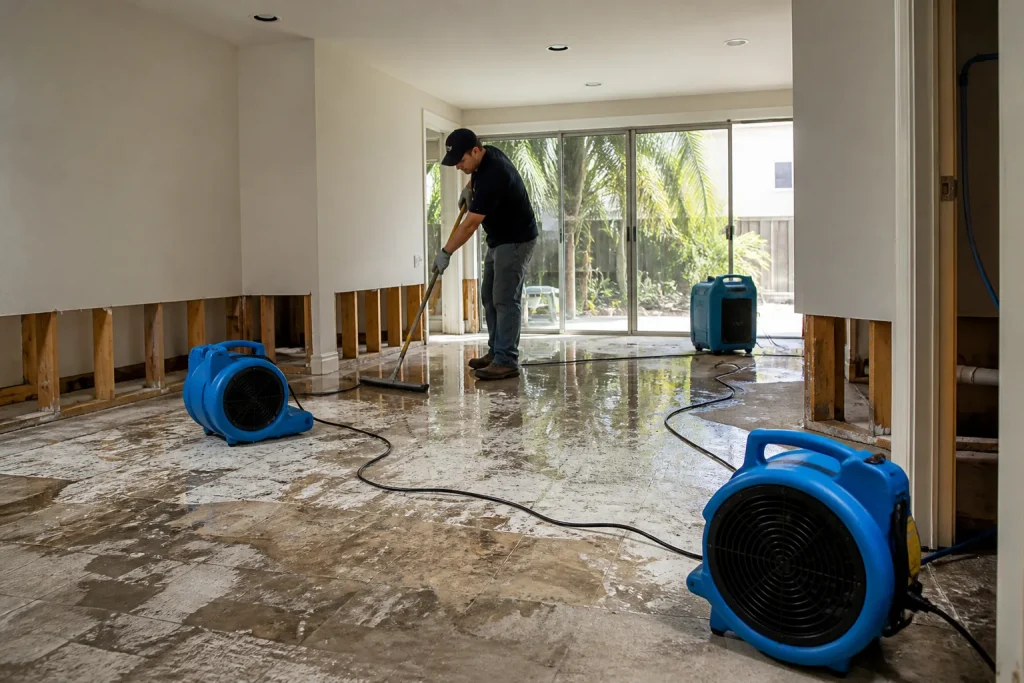
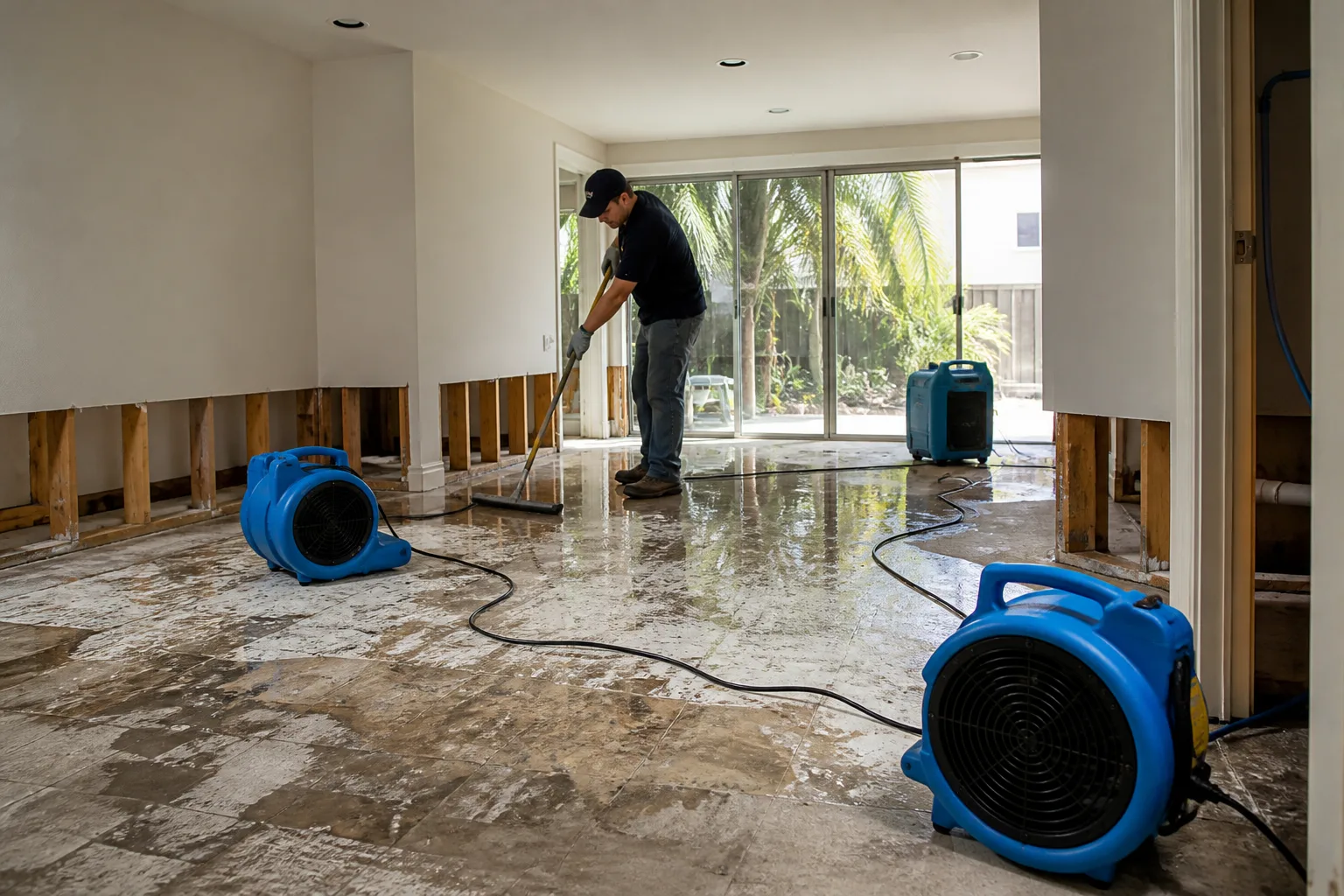
A properly executed structural drying job in a Costa Mesa home typically involves:
- Initial extraction within hours of the loss. Standing water removed with truck-mounted or portable extraction units.
- Moisture mapping conducted before equipment placement. A certified technician uses moisture meters and thermal imaging to identify the full extent of water migration, not just the visible wet spot.
- Targeted equipment placement based on the moisture map. Air movers positioned to create airflow across wet surfaces, dehumidifiers sized to the cubic footage of the affected space.
- Daily monitoring with documented readings. The drying plan adjusts as conditions change.
- Final verification against a defined dry standard. The job isn’t done until the moisture content of affected materials matches the established baseline for unaffected materials in the same structure.
What you should not see: a contractor who sets up fans, hands you a bill, and disappears. A contractor who doesn’t document anything. A contractor who says “we’ll check back in a week.” In our experience, the jobs that go wrong in Costa Mesa are the ones where documentation and daily monitoring were skipped, not where the initial extraction was slow.
When to Call a Pro
Some situations are clearly in “call a specialist” territory. Water from a sewage backup or toilet overflow contains bacteria and requires professional sanitation. Water that has sat for more than 48 hours has likely begun supporting microbial growth. Any water intrusion into wall cavities where you can’t see the full extent of migration needs professional assessment. Visible mold covering more than about 10 square feet should trigger professional remediation with containment. Fire damage always requires professional assessment because of smoke residue, structural compromise, and water from firefighting efforts.
If you’re in Costa Mesa and any of these apply, don’t wait for the damage to grow. Call Oxford Restoration Co at (877) 265-8058.
The Bottom Line
Choosing a restoration company under pressure is hard because the system is set up to favor contractors who move fast and talk well. But the technical truth is straightforward: individually certified technicians, specific scopes of work, transparent documentation, and quality equipment are the four things that separate legitimate restorers from general contractors in a restoration mask.
Ask for certification numbers and verify them. Read your scope of work line by line. Question any contractor who pressures you into signing before you understand what you’re signing. Insist on daily documentation.
If you’re in Costa Mesa and need help, Oxford Restoration Co offers free estimates. Call (877) 265-8058 and talk to a specialist, not a salesperson.
Frequently Asked Questions
How do I verify a restoration company’s IICRC certification?
Ask for the names and certification numbers of the individual technicians who will work on your property, then look those numbers up directly in the IICRC’s public database. A firm-level certificate is not the same as individual technician certification. If the company won’t provide individual certification numbers, keep looking. Call us at (877) 265-8058 if you want to skip the verification process and talk to a certified technician directly.
What should a water damage restoration scope of work include?
A legitimate scope includes measured square footage of affected areas, the number and type of air movers and dehumidifiers to be used, containment specifications for mold jobs, and a defined dry standard based on moisture readings from unaffected materials. Vague language like “dry to industry standard” without a measurable number is a warning sign. For a scope you can trust, call (877) 265-8058.
Is restoration covered by homeowners insurance in California?
Most standard California homeowners policies cover sudden and accidental water damage, such as a burst pipe, and mold remediation when it results from a covered water loss. Gradual leaks and pre-existing mold are typically excluded. Fire damage is covered under standard policies. Direct billing keeps you in control of the claim; assignment of benefits gives that control to the contractor. We document everything with photos and daily logs and work directly with adjusters, which makes claims go smoother.
How long does structural drying take?
Proper structural drying typically takes three to five days, though Costa Mesa’s coastal humidity can extend that timeline. The determining factor is the moisture content of affected materials versus established dry standards from unaffected materials in the same structure, not a calendar date. A company that promises a fixed completion date before inspecting the job is guessing. Call (877) 265-8058 for an honest assessment based on actual readings.
Written by the team at Oxford Restoration Co, serving Costa Mesa since 2011.
Need Damage Restoration Help?
Call Oxford Restoration Co — licensed & insured, here with fast after-hours help in Costa Mesa.
(877) 265-8058