
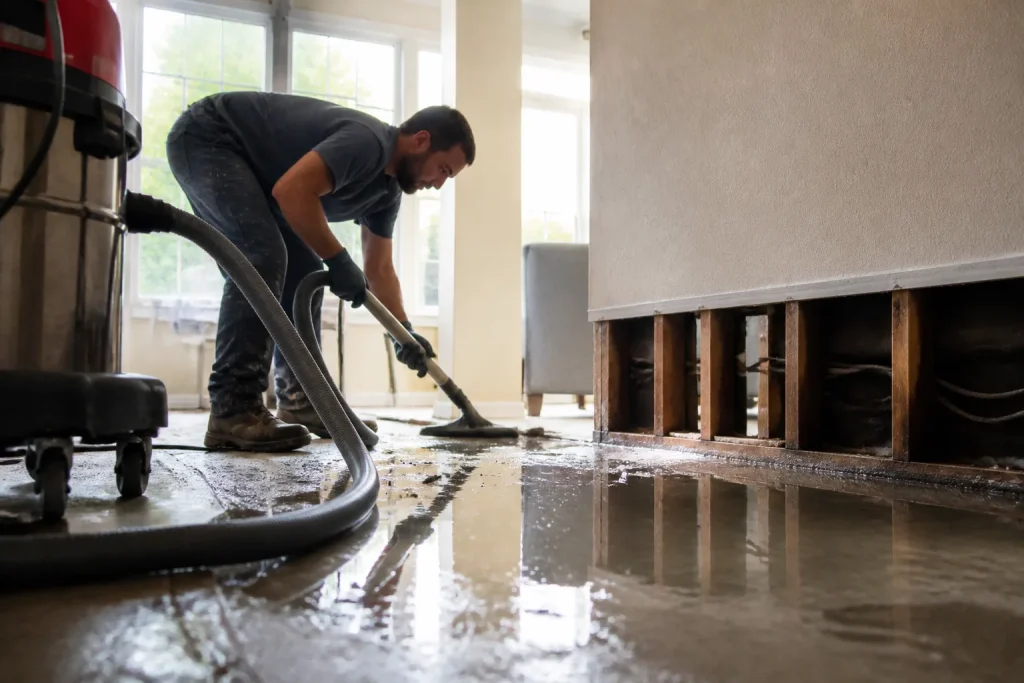
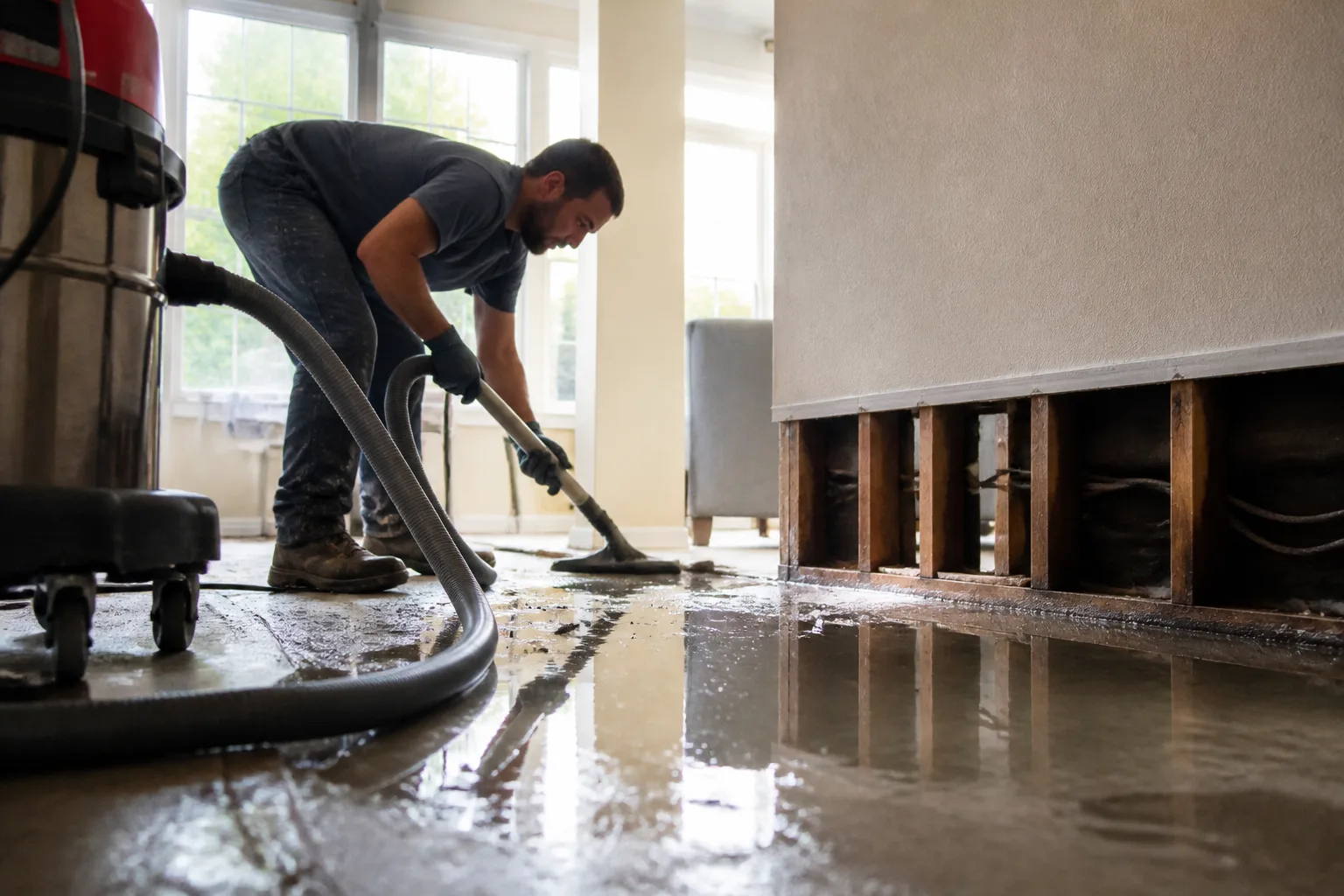
Emergency Water Damage Restoration Near Me: What Costa Mesa Homeowners Should Do First
If you’ve just discovered water pooling across your Costa Mesa floors or a soaked wall after a supply line let go, the first thing to do is stop the water at its source if you safely can, kill power to the affected areas, and document everything with your phone before moving a single piece of furniture. Then call a certified restoration specialist, not a general contractor, because the first 60 minutes determine whether this becomes a $6,000 mitigation job or a $20,000 reconstruction. If you’d rather not handle any of it yourself, call (877) 265-8058 and we’ll walk you through the first steps while a crew heads your way.
We pulled a saturated bathroom vanity out of a home near Fairview Park last spring where the homeowner had spent three days running box fans on the drywall, convinced he was handling it. The water was from a toilet supply line, which is clean, but what he didn’t know was that the wall cavity behind the vanity had never dried and mold was already blooming inside the stud bay by the time we opened it up. The fans felt like action. They actually just moved moist air around and bought the damage time to spread.
The First 60 Minutes: What Actually Moves the Needle
Everyone talks about acting fast after water damage, but nobody tells you what “fast” means in concrete terms. In Costa Mesa, where summer humidity hovers high and coastal air keeps wet materials from drying on their own, the clock starts the moment water touches drywall, baseboards, or flooring. Here’s what the first hour should look like, in order.
First, identify the water source category. This determines everything downstream, including whether you should be standing in the room at all. Clean water from a supply line or water heater is Category 1. Gray water from a washing machine, dishwasher, or shower drain carries biological contaminants and needs different handling. Black water from sewage backup, toilet overflow beyond the trap, or outside flood water is a health hazard, and you should not be in that space without protective gear. Spend five minutes tracing where the water came from and what it passed through on its way to your floor. If there’s any chance of contamination, stay out and let a professional assess it.
Second, stop the source. Shut the valve at the fixture if there is one. If not, kill the main water line at the street. Costa Mesa homes built in the 1960s and 70s often have aging gate valves that seize, so know where your main shutoff is before an emergency, and expect to use a meter key if the valve is at the street. Don’t attempt to fix a cracked supply line yourself. The goal is simply to stop flow, not to make repairs.
Third, isolate power. Water and live electrical circuits don’t mix. Shut off breakers to any affected rooms. If the water is above outlets or near the panel, don’t enter the room. Call your utility provider or an electrician before anyone steps into standing water. This is the step homeowners skip most often in the scramble to save belongings. It’s also the step that causes secondary injuries at a moment when the emergency is already unfolding.
Fourth, document before you touch anything. Pull out your phone and take wide shots of every affected room, then close-ups of saturated baseboards, wet carpeting, standing water, and the source of the leak if visible. Photograph water height lines on walls, contents that got wet, and the condition of the area before you move so much as a dining chair. Insurance adjusters use these photos to establish pre-mitigation conditions, and they matter enormously for your claim. Once you start moving furniture or cutting into walls, that initial record is gone.
What Not to Do: The Mistakes That Compound the Damage
The box fan lesson from Fairview Park isn’t unique. We see the same handful of well-intentioned missteps across Costa Mesa homes every time the rainy season or a slab leak hits. Here’s what gets people into trouble.
- Running household fans on wet drywall. A box fan moves surface air and does almost nothing to dry inside wall cavities. Worse, if the water is gray or black, it aerosolizes whatever is in the water and distributes it through your living space. You could be turning a plumbing issue into an indoor air quality problem.
- Using a shop vac on carpet without extracting the pad. The carpet fibers may feel dry to the touch while the pad underneath stays saturated. Wall-to-wall carpet in Costa Mesa sits on a pad that behaves like a sponge. Drying the surface creates a false sense of resolution.
- Pulling up flooring before documenting it. Once you start removing materials, you’ve altered the evidence. Adjusters rely on photos and material samples to determine coverage. Demo before documentation is a recurring reason claims get partially denied.
- Calling a general contractor first. A contractor is looking for what can be rebuilt. A certified restorer is looking for what can be saved. The difference shows up in the claim line items. More on this below.
When we arrive at a Costa Mesa home, the first thing we do is map the moisture migration. Water moves sideways through drywall, underneath base plates, and across concrete slab. What looks like a small wet patch in the corner of a living room often traces back to water that has traveled six feet under the flooring. Our job is to find the full extent of it before we start washing the walls with hope.
Why Your Insurance Company Is Watching What You Do Before We Get There
Costa Mesa homeowners are often surprised to learn that their actions in the hours before a restoration crew arrives are being evaluated for reasonableness by their insurer. The policy language is dense, but the practical reality is straightforward: an insurer expects you to take reasonable steps to prevent further damage. What counts as reasonable gets scrutinized.
If you shut off the water and move your living room furniture away from a wet area, you’re doing what any prudent person would do. That’s mitigation, and it’s looked on favorably. If you start pulling batts of insulation out of the wall without documenting the pre-loss condition, or if you leave standing water in place for three days while deciding whether to file a claim, that’s a different story. Adjusters use the phrase “failure to mitigate” more often than most homeowners realize, and it becomes a gateway to partial denial or reduced coverage.
One particular pattern we see in Costa Mesa involves the general contractor who comes out first. The homeowner calls the contractor they know from a kitchen remodel, the contractor tears out wet drywall and gets the place opened up, and then the insurer questions whether the tear-out was necessary or excessive. When that happens, the claim line items for drying and reconstruction get picked apart. Certified restorers document and justify the scope as they go, which gives the insurer a defensible chain of reasoning for what needed to be done. This is why a specialist matters from the very first phone call.
How to Vet a 24/7 Restoration Response
A company can run “24/7 emergency service” in a radio ad without having a single truck actually staffed at midnight. Here’s how to tell the difference when you’re standing in six inches of water at 2 a.m. in Costa Mesa.
When you call, ask four questions:
- What does a dispatch actually look like right now? You want to hear a specific arrival window, not “we’ll get someone out there.” If the person on the line can’t commit to a window, they’re a lead aggregator fishing for jobs, not a restoration company.
- What equipment is on the truck? An emergency response truck should carry air movers, dehumidifiers, and extraction tools from professional-grade manufacturers. We run Dri-Eaz and Phoenix desiccants, XPOWER air movers, and B-Air filtration systems. If the answer is vague, you’re talking to someone who doesn’t know the equipment.
- Are you IICRC-certified? The Institute of Inspection, Cleaning and Restoration Certification is the standard in the restoration industry. A company that can’t answer this question clearly hasn’t invested in the credentialing that separates restoration specialists from contractors in rain boots.
- How do you handle wall cavities? If the answer involves tearing out every wet wall to the studs, that’s a red flag. Cavity drying systems like Injectidry can dry inside wall assemblies without full demo, which reduces scope, cost, and disruption. If a company doesn’t have that option, they may be scoping unnecessarily aggressive work.
A real restoration company dispatches a crew that arrives with a moisture meter in hand, maps the extent of water migration, and explains what they’re going to do before they plug in a single piece of equipment. The first question we ask at the door is “Where is the water source, and what category is it?” If you’re already in our truck schedule, we’ve asked that on the phone before we left the shop.
What Secondary Damage Actually Costs in Costa Mesa
Secondary damage is what happens after the initial water event. It’s the swelling baseboards, the delaminating cabinet plywood, the mold that begins to colonize inside wall cavities within 48 to 72 hours in the right humidity. Your initial claim covers the pipe that leaked and the wet carpet. Secondary damage is where the scope and cost escalate, and in Costa Mesa’s coastal climate, it escalates fast.
A $6,000 drying job turns into a $20,000 reconstruction when the water gets into adjacent building materials and sits there. Hardwood floors cup. Tile lifting over the slab pulls loose. Crown molding splits at the miters. None of this happens in the first ten minutes, but it begins the moment you stop regulating the indoor climate in the affected area.
This is why we don’t send homeowners to the hardware store for a dehumidifier and call it good. A consumer unit pulls a few pints a day. The Dri-Eaz and Phoenix units we deploy pull gallons and hold the indoor environment at a specific humidity range calculated from the affected materials, the outdoor dew point, and the air movement in the room. Costa Mesa sits in a warm-maritime climate that makes uncontrolled drying nearly impossible from July through October. A professional-grade drying plan accounts for that. A box fan doesn’t.
The Right Order of Operations for a Costa Mesa Claim
Here’s the sequence we recommend to homeowners who want to protect both their home and their claim.
- Stop the water. Find the shutoff and kill it. Seconds matter more than property at this stage.
- Photograph everything. Wide shots, close shots, source shots. Don’t move an item without a photo of where it sat.
- Shut off power to affected zones. If you can’t reach the breaker safely, stay out and call your utility.
- Call a certified restorer, not a contractor. Ask the four questions above. Lock in a dispatch window.
- Contact your insurer. Get a claim number started and let them know a mitigation crew is en route. We can talk to your adjuster directly if you’d prefer. Direct coordination between restorers and adjusters saves weeks of back-and-forth on scope.
- Don’t attempt demo. No pulling baseboards, no cutting drywall, no ripping carpet. Let the restorer document, scope, and decide what comes out.
We once had a Costa Mesa homeowner who’d pulled every wet baseboard off the wall the night before we arrived, stacked them in the garage, and thrown the carpet pad out to the curb before the claim was filed. His insurer denied the carpet and pad line items outright because there was no physical evidence of pre-loss condition. The adjuster wasn’t being unreasonable. He literally had nothing to assess. Don’t be that homeowner.
When to Call a Professional
If the water source is anything but a clean supply line, if the affected area includes a wall cavity, if there are adjacent rooms below or beside the wet area, or if you’re already two days into a drying attempt that isn’t working, stop and call. The longer the water sits, the more invasive and expensive the response becomes.
For Costa Mesa homeowners, the local terrain matters. Concrete slab construction, which is predominant across most of the city’s housing stock, holds moisture and wicks it upward into flooring. Coastal air slows natural evaporation. In older neighborhoods like Eastside and the Westside, wall assemblies are often original and tight, which means water trapped inside doesn’t release without mechanical drying. We bring professional-grade equipment and IICRC-certified procedures to every job because the physics of drying in Costa Mesa demand it.
If you’re already dealing with water damage, you may also want to explore our related services. Our Water Damage Restoration in Lakeview page covers the full mitigation process for Costa Mesa-area homes. If mold has already begun from a prior water event, see Mold Remediation in Lakeview. And if the source was a fire suppression system or related event, Fire Damage Restoration in Lakeview explains how we handle combined water and smoke damage. Every one of these services operates under one Oxford Restoration Co home umbrella, so you never get handed off between companies mid-claim.
The Bottom Line
The first hour after water damage in Costa Mesa is the highest-leverage window you have, and it’s not about fixing anything. It’s about stopping the source, shutting off power, documenting the scene, and calling a certified restoration specialist before the damage compounds into something far more expensive. The fans and shop vacs that feel like action often make things worse. The homeowners who call early, document thoroughly, and let a professional handle the drying end up with smaller claims and faster returns to normal.
If you’re in Costa Mesa and dealing with water damage right now, Oxford Restoration Co offers free estimates. Call (877) 265-8058 and we’ll talk through your situation, answer the category question, and get a crew headed your way if that’s what the scene calls for.
Frequently Asked Questions
How fast can you get to a water damage emergency in Costa Mesa? Our emergency response line is staffed 24/7, and for Costa Mesa calls we typically have a crew on site within the hour. When you call (877) 265-8058, we’ll confirm the address, ask you about the water source and affected areas, and lock a specific arrival window for the team.
What should I do before you arrive? Shut off the water source if safe, kill power to the affected rooms, and photograph everything: rooms, walls, flooring, contents, and the leak source. Then sit tight. Don’t move furniture or attempt to dry anything. Your job is to preserve the scene, not resolve it.
Will insurance cover my water damage? Most Costa Mesa homeowner policies cover sudden and accidental water damage from supply lines, appliance failures, and water heaters. Gray and black water entries and long-term seepage get more complicated. We coordinate directly with adjusters and provide the photo documentation and scope detail that keeps your claim moving.
Do I really need an IICRC-certified company, or can my contractor handle it? You need a certified restorer. An IICRC-certified company operates to the restoration industry’s recognized standard for drying, scope, and documentation, which insurers understand and respect. General contractors are good at rebuilding what got taken out. They’re not trained to answer the question of what needed to come out in the first place.
Should I run fans and a dehumidifier while I wait? No. Household fans move surface air and can aerosolize contaminated water. They don’t dry wall cavities or subfloor, and they give you a false sense that the problem is contained. Let a professional with industrial-grade equipment and proper air filtration take over.
Written by the team at Oxford Restoration Co, serving Costa Mesa since 2011.
Need Damage Restoration Help?
Call Oxford Restoration Co — licensed & insured, here with fast after-hours help in Costa Mesa.
(877) 265-8058